Critical Analysis
An observation in making the villain the hero in Terminator 2: Judgement Day and Star Wars Episode VI: Return of the Jedi.
s5204667
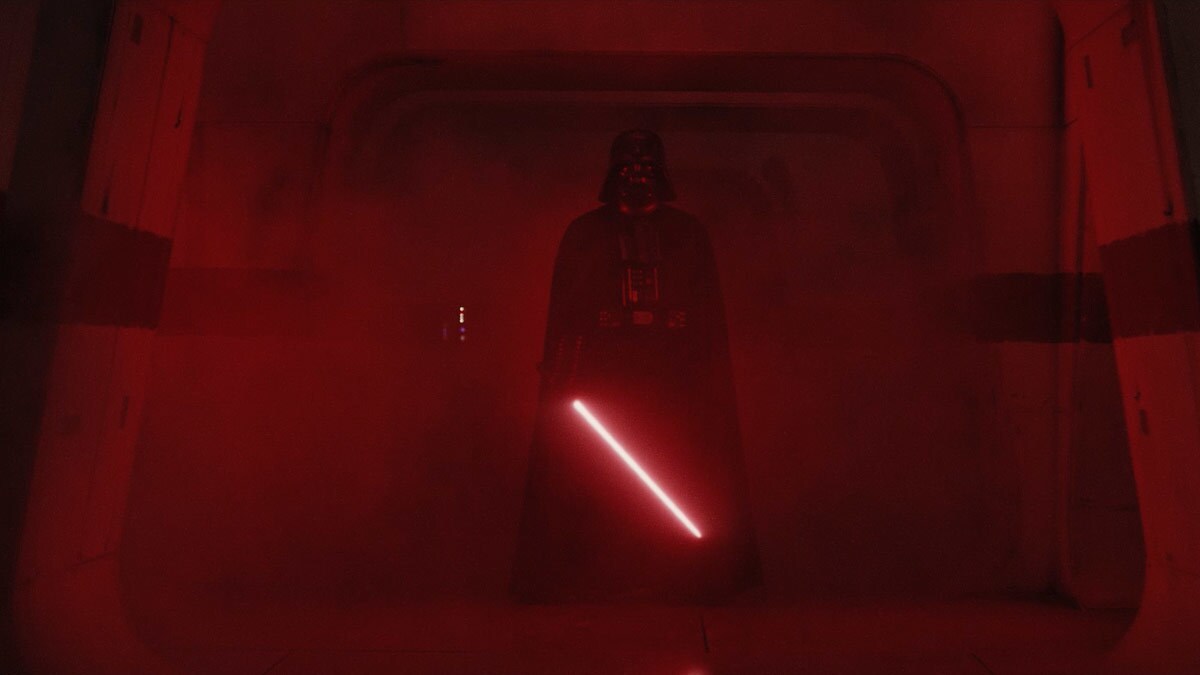

The villain of a film is arguably the second most important role, being the catalyst for the protagonist’s adventure, and setting up the main plot of the film. But some films, such as Star Wars Episode VI: Return of the Jedi (Richard Marquand, 1983) and Terminator 2: Judgement Day (James Cameron, 1991) made their respective villains the heroes of the film.
Return of the Jedi portrays the character of Darth Vader as a villain, as he has been in Star Wars Episode IV: A New Hope (George Lucas, 1977) and in Star Wars Episode V: The Empire Strikes Back (Irvin Kershner, 1980). The plot of Return of the Jedi revolves around Luke Skywalker, Han Solo and Princess Leia travelling to a planet named Endor to disable a shield allowing for a fleet to destroy a superweapon, the Second Death Star. It also has a subplot of Luke finding his destiny with his father, Darth Vader, and their final confrontation in the presence of the Emperor, who intends to manipulate Skywalker to his own needs.
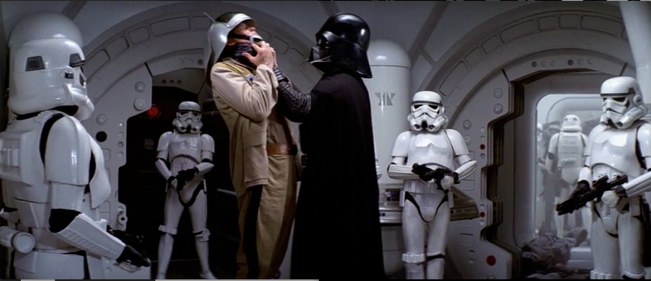
He is a represented as an evil character in the trilogy through many different camera techniques and methods; a lot of the shots of him centre him in the frame, with a lower angle to make him seem more opposing and physically larger. The use of dolly and tracking shots also make his character seem opposing, as it forces the audience to focus on him whenever he is in frame. His design also constructs him as the villain; wearing an all-black suit is a signifier of evil, along with the red colour of his lightsabre; the half robotic suit connotes that he has a lack of emotion, and is something less than human, which is also connoted in the lack of identity by him wearing a helmet. He has been constructed so the audience feel no sympathy for him or his actions, and this is achieved by portraying him as a killer without remorse. Vader can be said to have been constructed as a part of the Hero’s Journey model, as his actions influence the journey of the protagonist, and is the main obstacle in their conclusion, which happens in this case at the end of Return of the Jedi, following what Campbell translated as a rite of passage, ‘the return’. (1993, p. 193)
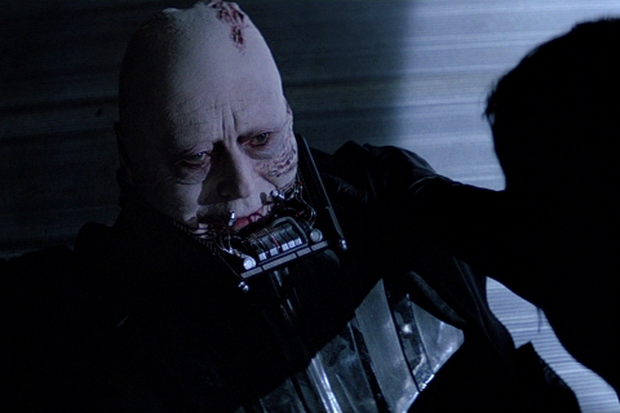
In Return of the Jedi, Vader’s character is the same from the previous films in the beginning, but this changes at the end of the third act. This is done by showing him to have emotions, which is most evident when he is talking alone with Luke at the end of the second act. The final confirmation of this change, is when he saves his son from death, sacrificing himself in the process and vanquishing the main villain of the film. Also, at the end of the film, we see the man underneath the suit, Anakin Skywalker, become ‘one with the Force’, which has been interpreted as an ascension to heaven. There have been different interpretations as to why Vader was changed to a hero, when in the previous films he was portrayed staunchly as a villain. When the film was released, many assumed a final confrontation between good and evil to end the trilogy, which did happen, but not with whom the audience expected. This suggests that the studio wished to create a plot twist, to capitalise on the critical and commercial success of The Empire Strikes Back, which arguably has one of the best plot twists in film history, as well as being regarded as the greatest Star Wars film.
Another interpretation is from the creator, George Lucas. He has stated that the saga is about the ‘tragedy of Darth Vader’ (2008, p. 74) connoting that he had planned this to happen ever since he wrote the original screenplay. However, this creates issues with interpretations. Using this statement from Lucas implies that the audience need to have seen the films in the prequel trilogy in order to understand the context behind Anakin’s fall, and as such the context to his redemption. Audience interpretations of Darth Vader’s change would likely have been different before the release of the prequel films. One major interpretation afforded by Darth Vader’s ‘redemption’ is in relation to the title. Considering Anakin being the centre focus of the saga, it can be assumed that the title refers to Anakin, rather than Luke. This in turn makes Anakin the protagonist of the film; as stated by Davis: “But there is still ambiguity, as the term protagonist is also widely taken to refer simply to the central character.” (2016, p. 126). This interpretation may have only been suggested by the studio, in order to keep Luke as the main character and therefore their biggest selling point. On the other hand, the interpretation could fit into Lucas’s statement, as well as ideologically signifying the idea that good can prevail, which is justified by the target audience of the films, and the several religious ideals the saga draws from.
Terminator 2: Judgement Day uses a similar, and yet very different model to making the villain a hero. The plot of T2 revolves round a reprogrammed T-800, the one sent back in time to kill Sarah Connor in The Terminator (James Cameron, 1984), being sent back in time to protect a young John Connor, who is being hunted by the more advanced T-1000 to prevent John from becoming the leader of the resistance in the future. The main difference between this and Return of the Jedi, is that the Terminator is never a villain in this film but was in previous films. Regardless of this, the film constructs the T-800 in a way that blurs the lines between good and evil, which is a key part of the narrative throughout the film. This makes the narrative of the film layered with ideological meanings and interpretations, but it also makes the character construction of a simple character become far more complex with equally thoughtful interpretations on the future of technology.
In T2, the first thirty minutes of the film construct the T-800 as the villain of the film, as it is the same actor from the first film playing the same character, indicting audiences to draw upon their knowledge of the construction of the T-800 in that film and apply it to T2. This is also compounded by the introduction of the T-1000, making the audience think about what the objective of each Terminator is, and as such work out which one is the villain. The way in which they are both constructed to be evil is shown in different ways; they both act robotic, conveying a massive lack of human emotion, alienating them from the audience; they both use violence to get where they need to be and they both look for a way to search for John Connor. They are also both framed and positioned to be bigger and take up more space, connoting their danger and forcing the audience to pay attention to their actions. This is all changed in the middle of the first act, in which the T-800 attacks the T-1000. This confirms that the older model was never sent to kill John, which he explains later in the film. Regardless of what the Terminator said, the next act in the film focuses on the fact that although he is to protect John, he still reflects an emotionless killer.


The second act of the film follows John and the Terminator freeing Sarah Connor and aiming to prevent the cause of Judgement Day, a nuclear holocaust caused by computers. Throughout this act, John tries to teach the Terminator how to be human, by telling him to not kill people for the sake of it, and to try and think more beyond his programming. This change is intended to evoke sympathy for the Terminator, as the audience learn that the Terminator cannot think upon its own free will and as such is merely a pawn. This is best shown in a deleted scene, in which John changes the processor of the Terminator allowing it to think for itself, however Sarah threatens to destroy the chip, pleading to John that they don’t know what it could do to them. This scene, although not in the original cut, is crucial in sympathising for the Terminator, as Sarah threatens to kill him based upon her own experiences, and not on John’s word that the new Terminator has changed. There a few close-up shots of the inactive Terminator, as they argue over its life, making this scene so crucial, as it gives a machine purpose and a life. This is a massive contrast to the first film, which reflects future robots, and essentially the future of technology as something to be feared, but this scene challenges that completely, making a killer robot seem human which does equal amounts connoting positives of the future of technology as it does the value and possible issues with humanity and human interactivity with technology.
The finale of the film is the best example of the Terminator rejecting its old ways and using what it has been taught by John to make itself better. Firstly, is citing John when he ‘kills’ the frozen T-1000, saying ‘Hasta la vista, baby’. John teaches this to the Terminator earlier in the film and shows how a machine can learn from human behaviour and change its own thoughts. Secondly is after the death of the T-1000, when the T-800 voluntarily sacrifices itself in order to prevent its technology to be taken and exploited. Firstly, the choice it makes to sacrifice itself for the sake of humanity is evidence of its development and understanding of human life, which it didn’t have at the beginning of the film. Most importantly is the quote that he gives John before being killed; ‘I know now why you cry, but it’s something I can never do’. He understands John’s emotion, but stands by his decision, which shows a much more developed understanding that machines are different from humans, and he knows this because he can think for himself. A last monologue by Sarah Connor confirms this, ‘if a machine, a Terminator, can learn the value of human life, maybe we can too’.
Possible interpretations why the T-800 was changed come from the advancements in technology. The T-1000 saw breakthroughs in the use of CGI technology, so it’s possible that the T-800 is made a hero to directly show the contrast between itself and the T-1000. James Cameron said that ‘if the 800 series is a kind of human panzer tank, the 1000 had to be a Porsche.’ (The Making of Terminator 2: Judgement Day 1991), reflecting the different styles of each Terminator. This could also be applied to suggest that the change is a reflection on the redundancy of old technology and could also suggest that too many advancements in technology pose more threats than positives. Another possible interpretation is based upon the end of the Cold War. The Cold War ended in December 1991, but the representation of a villain being an ally could link to improving Soviet relations during the final years of the war.
Return of the Jedi and T2 have very similar ways in ‘rebranding’ their villains as heroes. One major point used is the importance of human emotion. Return of the Jedi uses audience knowledge about Vader in order to construct him as a regular villain but uses Luke to make him realise his true feelings and emotions, drawing upon a father-son relationship and idealising that in the process. Subsequently, his unmasking scene, to reveal that he is indeed human conveys sympathy for Anakin, as we can see him as a human being trapped inside the persona of Darth Vader, personified by the black suit. T2 also uses human emotions to convey change, but in a different tone, the Terminator is treated like a child, being taught ‘humanity’ beyond his programming. This also evokes sympathy, because the film uses the audiences knowledge of the Terminator from the first film, and compares that with the one in T2, to find that a killer robot is reduced to have a child-like persona, leading them to realise that it isn’t the Terminator’s fault he is how he is, and can be something far more. One scene that both films share to convey these feelings is their respective endings, in which both characters sacrifice themselves. Here the audience are shown the development of their change and are instead of feeling happy at the death of a villain, are instead subverted by their changes to be shown as heroes, which evokes more emotion to the characters.


After identifying each films respective techniques into making their villains heroes, both Return of the Jedi and T2 successfully make their villains heroes, both in a narrative structure using the Hero’s Journey model, but also as a part of their overall character, sharing both identities of being evil and good without compromising the other’s impact and success.
Bibliography
Campbell, J. 1993. The Hero with a Thousand Faces [online]. 2nd edition. New York: Pantheon Books
Davis, R. 2016. Creating Compelling Characters for Film, TV, Theatre and Radio [online]. 2nd edition. London: Bloomsbury Academic.
Leyland, M., 2008. George Lucas. Total Film 20 May 2008. 138.
Star Wars Episode IV: A New Hope, 1977. [film, DVD]. Directed by George Lucas. USA: Lucasfilm Ltd.
Star Wars Episode V: The Empire Strikes Back, 1980. [film, DVD]. Directed by Irvin Kershner. USA: Lucasfilm Ltd.
Star Wars Episode VI: Return of the Jedi, 1983. [film, DVD]. Directed by Richard Marquand. USA: Lucasfilm Ltd.
Terminator 2: Judgement Day, 1991. [film, DVD]. Directed by James Cameron. USA: Carolco Pictures, Pacific Western Productions, Lightstorm Entertainment, Le Studio Canal + S.A.
The Making of Terminator 2: Judgement Day, 1991. [television programme]. Directed by David G. Hudson and Ed W. Marsh. USA. 9th September 1991, 17:32.
The Terminator, 1984. [film, DVD]. Directed by James Cameron. USA: Hemdale, Pacific Western Productions, Cinema ’84.
 Subverting Expectations